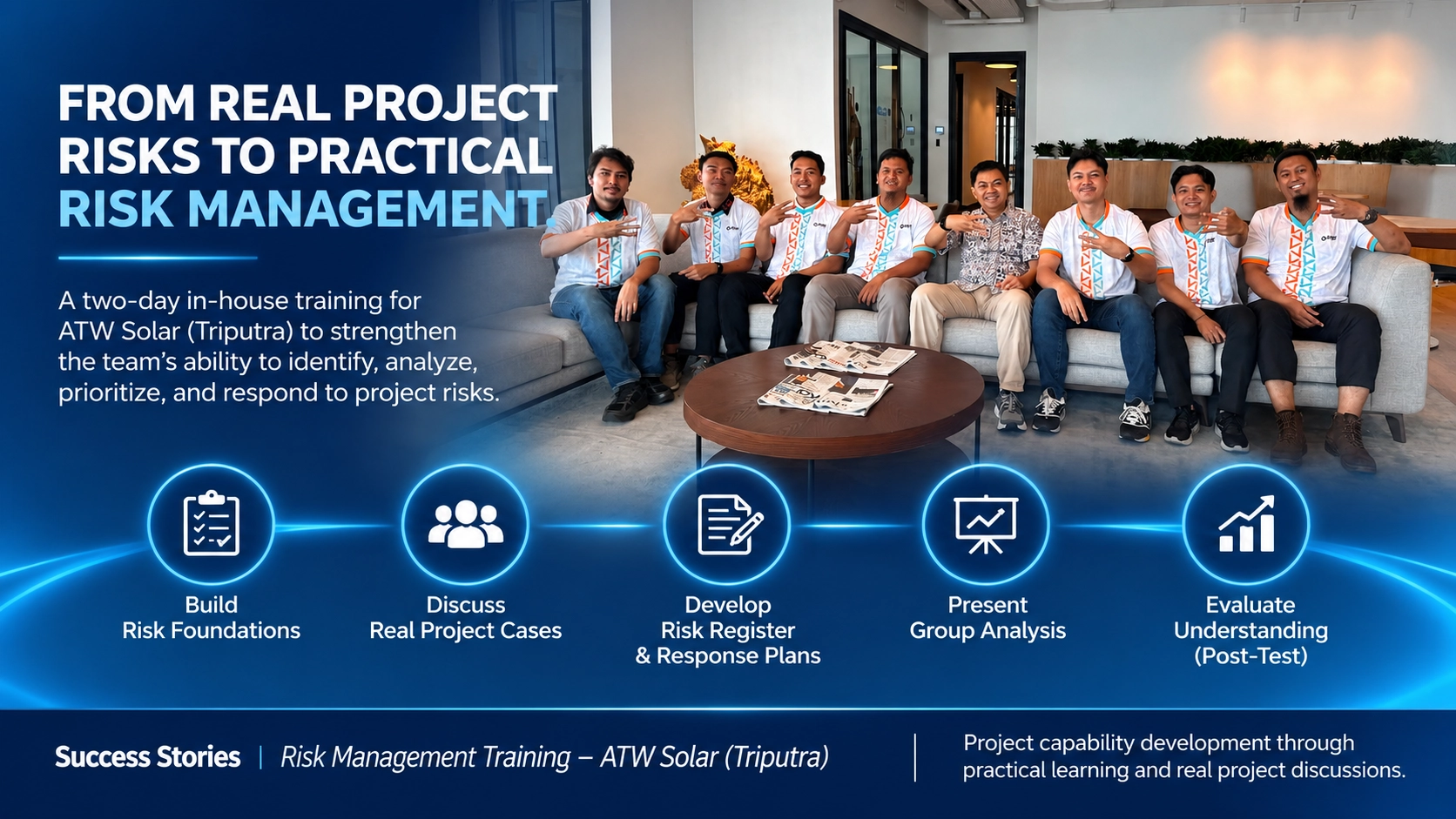

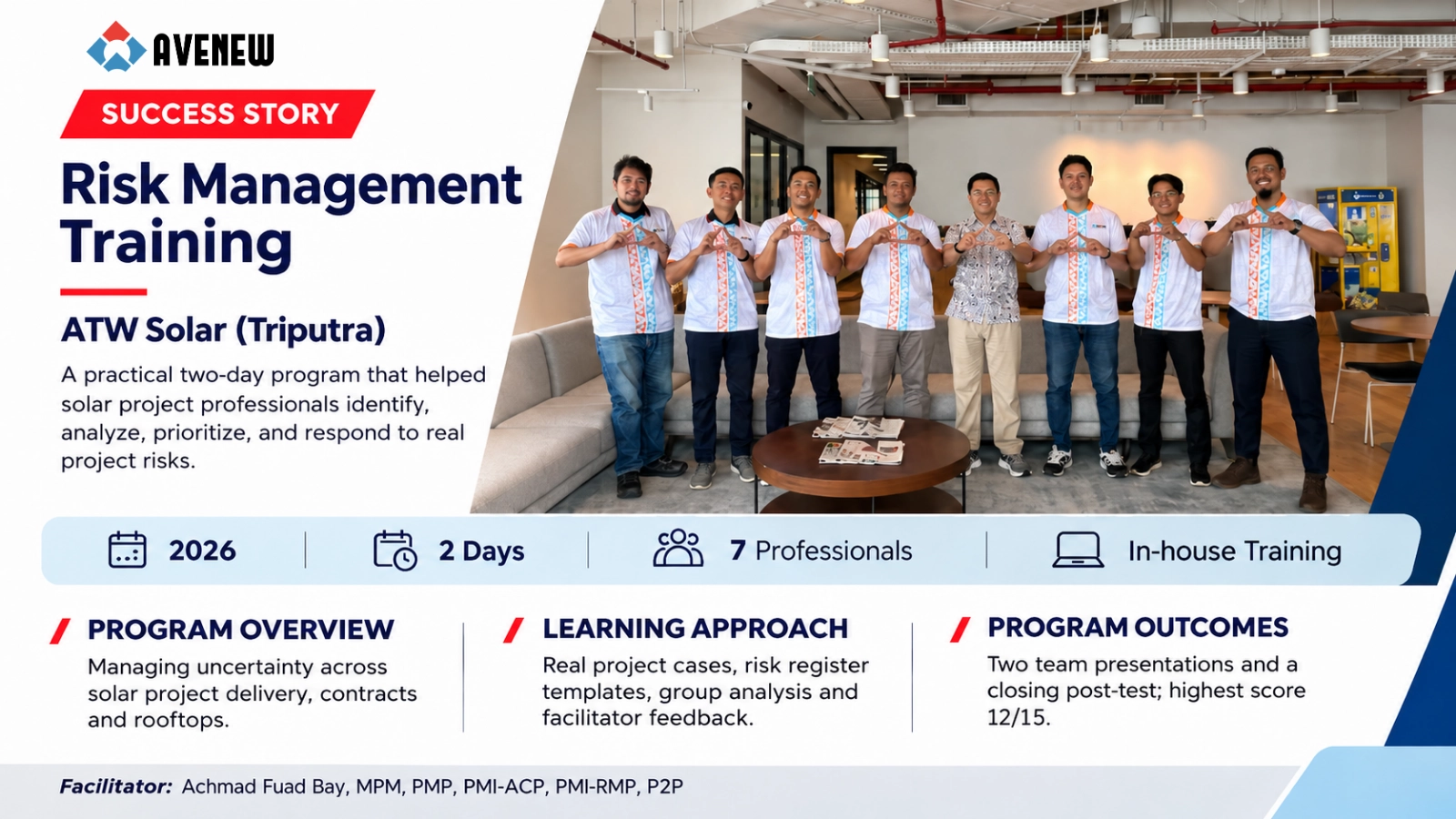
Over two days, ATW Solar’s project team took the risks they already live with, from unsigned contracts to unfit rooftops, and learned to capture, prioritize, and respond to them through a shared, structured approach.
A Returning Team With Real Questions
ATW Solar, part of the Triputra Group, works in the energy sector delivering solar power projects, including rooftop installations. In 2026, Avenew Academy delivered a two-day in-house Risk Management program for seven of the company’s project professionals. Five of the seven had trained with Avenew Academy before, in PMP preparation or Microsoft Project, so this program built on an existing project management foundation rather than starting from zero. The focus this time was narrower and more practical: how the team identifies, analyzes, and responds to the risks that shape its projects.
Where Risk Meets Contracts and Rooftops
The team was not unfamiliar with risk. They encounter it every day in the field. The questions they raised during the program showed where a more structured approach was needed. Participants described situations where a purchase order arrived before the contract was finalized, and asked whether scope discussions could begin at that point. Others noted that high-level planning often failed to capture the risks that only appear on site. One recurring theme was cost. The organization did not formally account for a cost of risk, which made it difficult to explain cost increases to clients or to the sales team. Participants also wanted to understand how cost of risk differs from cost of conformance, and which of the two should be reported to management.
A broader pattern also surfaced. Requirements agreed between the sales team and clients did not always match what the technical team understood it had to deliver. Each of these issues points to the same capability need. The team needed a common method and vocabulary to quantify uncertainty, prioritize what matters most, and communicate risk clearly to clients, colleagues, and leadership.
Learning Through Familiar Project Situations
The program was facilitated by Achmad Fuad Bay, MPM, PMP, PMI-ACP, PMI-RMP, P2P, whose combination of risk management and broader project delivery credentials allowed the sessions to move easily between principle and practice. From the opening session, discussion centered on the project culture participants knew from their own work. The case studies were chosen to reflect situations the team recognized, and participants engaged openly as a result.
The first day grounded risk management in the documents and decisions that define a project’s boundaries. Extended discussions covered the project charter, the relationship between purchase orders and contracts, and the role of project documentation. Participants also explored progressive elaboration, including whether it applies to shorter projects of four to six months rather than only to long-duration work, and where a project should be considered closed, whether at final payment or at formal closure of the charter. Later in the day, the facilitator introduced practical templates for building a risk register and developing risk responses. Participants were then divided into two groups and given a shared case project to analyze and present. The groups kept working and discussing well into the late afternoon.
The second day moved into risk analysis and prioritization, again supported by multiple case studies. By this stage, the questions had shifted from understanding concepts to applying them. Participants asked whether low-rated risks should be mitigated alongside high-rated ones, whether risk responses can change as a project progresses, whether opportunities identified in the response plan should be reflected in the project cost budget, and whether transfer is an appropriate strategy for a risk that is both highly probable and high in impact. One participant brought a live example: a rooftop solar project where the roof itself was not in suitable condition. The discussion that followed explored how such a risk could be addressed with the client, for example by requiring roof remediation before installation, and how the remaining exposure could be mitigated.
From Templates to Working Risk Plans
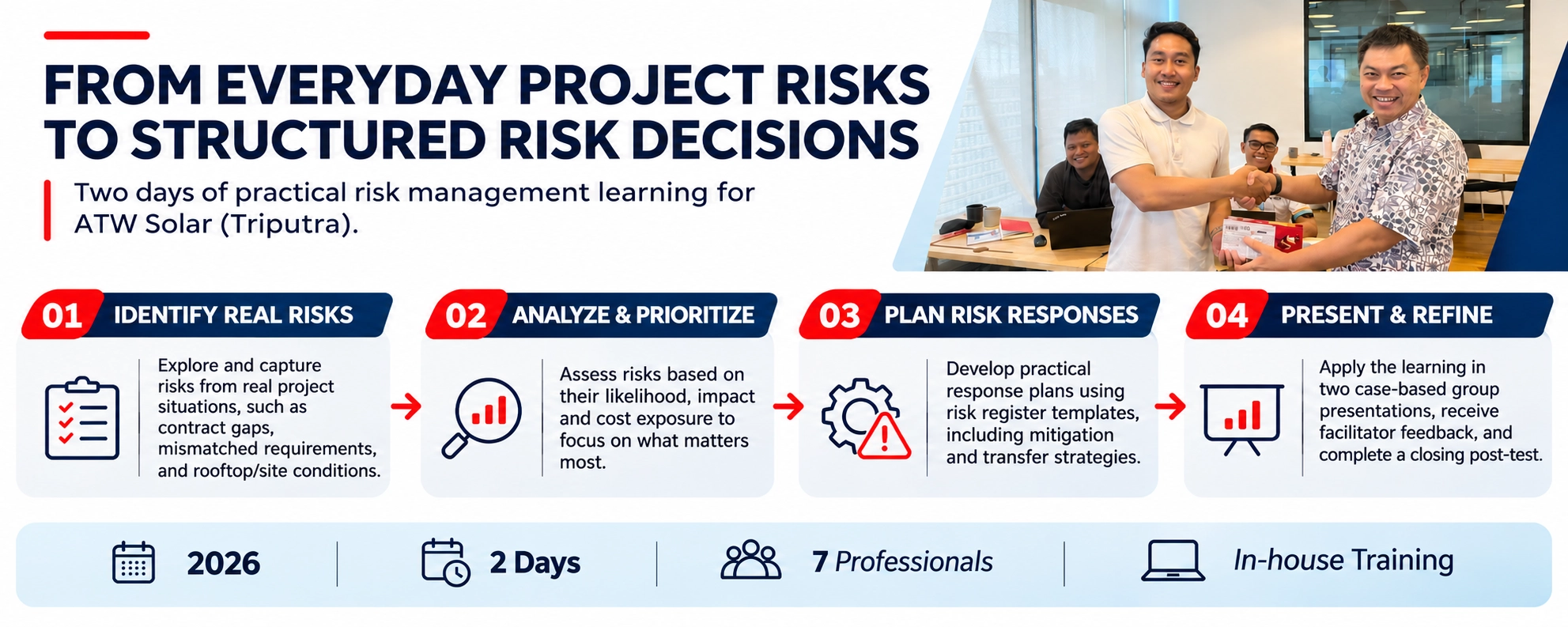
The clearest evidence of learning came from the group presentations at the end of the second day. Both teams analyzed the same case project and presented their risk work to the facilitator for structured feedback. One team delivered a complete and well-organized analysis. The other produced a more concise presentation that was easier to read, although some components were not yet complete. The contrast created a useful lesson about balancing thoroughness and clarity when communicating risk, which matters most when that information has to reach clients or management.
The program closed with a post-test to check understanding of the material, with the highest individual score reaching 12 out of 15. Throughout both days, participants stayed actively engaged, and their questions moved steadily from definitions toward real decisions on their own projects. That shift suggests the team left with more than familiarity with the concepts. They now have a working structure for the risk conversations they were already having informally. Participants also expressed interest in continuing their development in related areas such as contract management, which reflects how closely risk, contracts, and commercial agreements are linked in their work.
Capability Built One Conversation at a Time
For a team that has now worked with Avenew Academy across several programs, this training added a further layer to a capability that continues to grow. Avenew Academy’s role is not to deliver standalone courses but to help organizations like ATW Solar build the knowledge, shared language, and confidence their people need to deliver projects well. In this case, that meant giving a solar project team the tools to turn field experience into structured, defensible risk decisions.