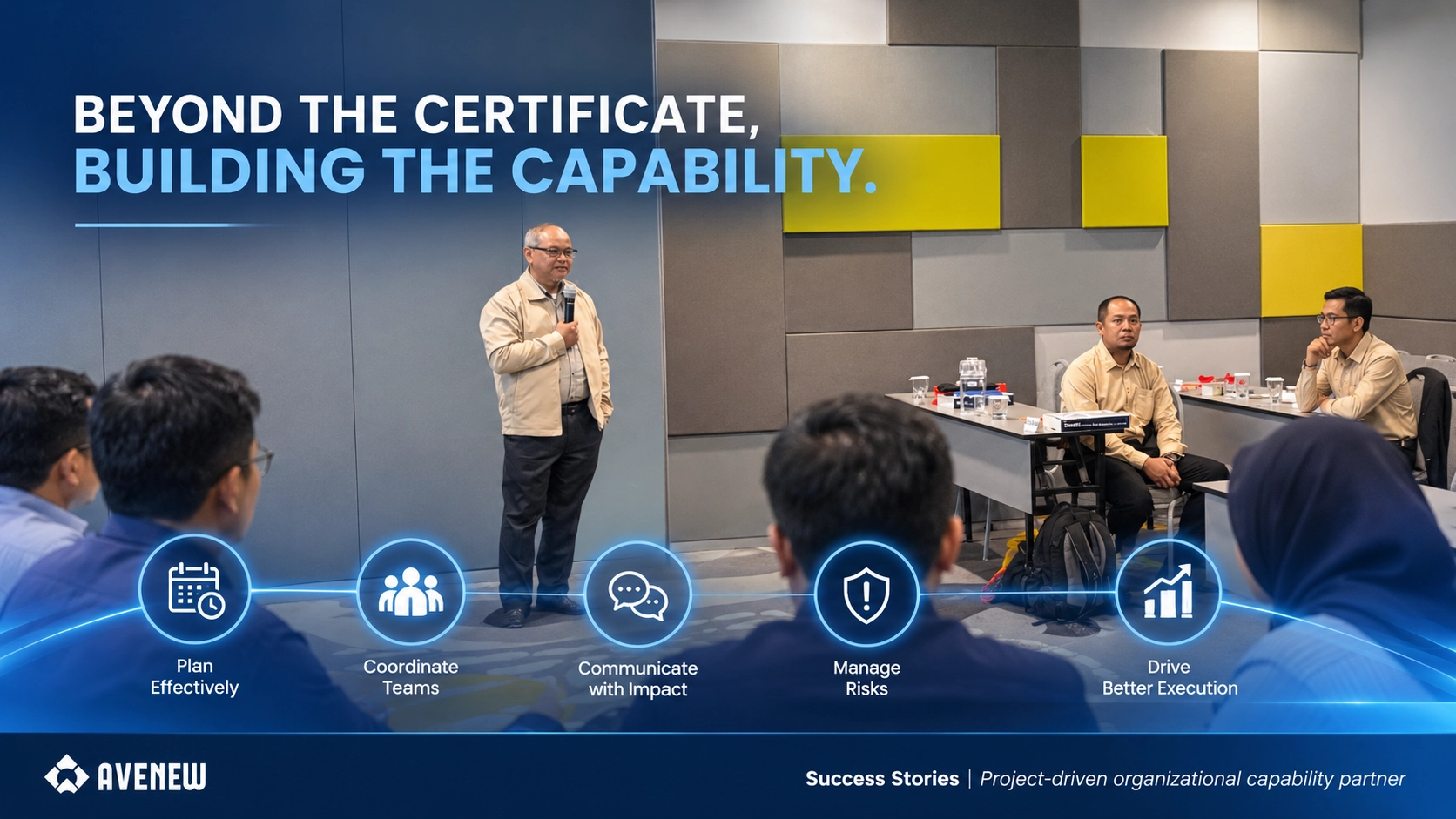
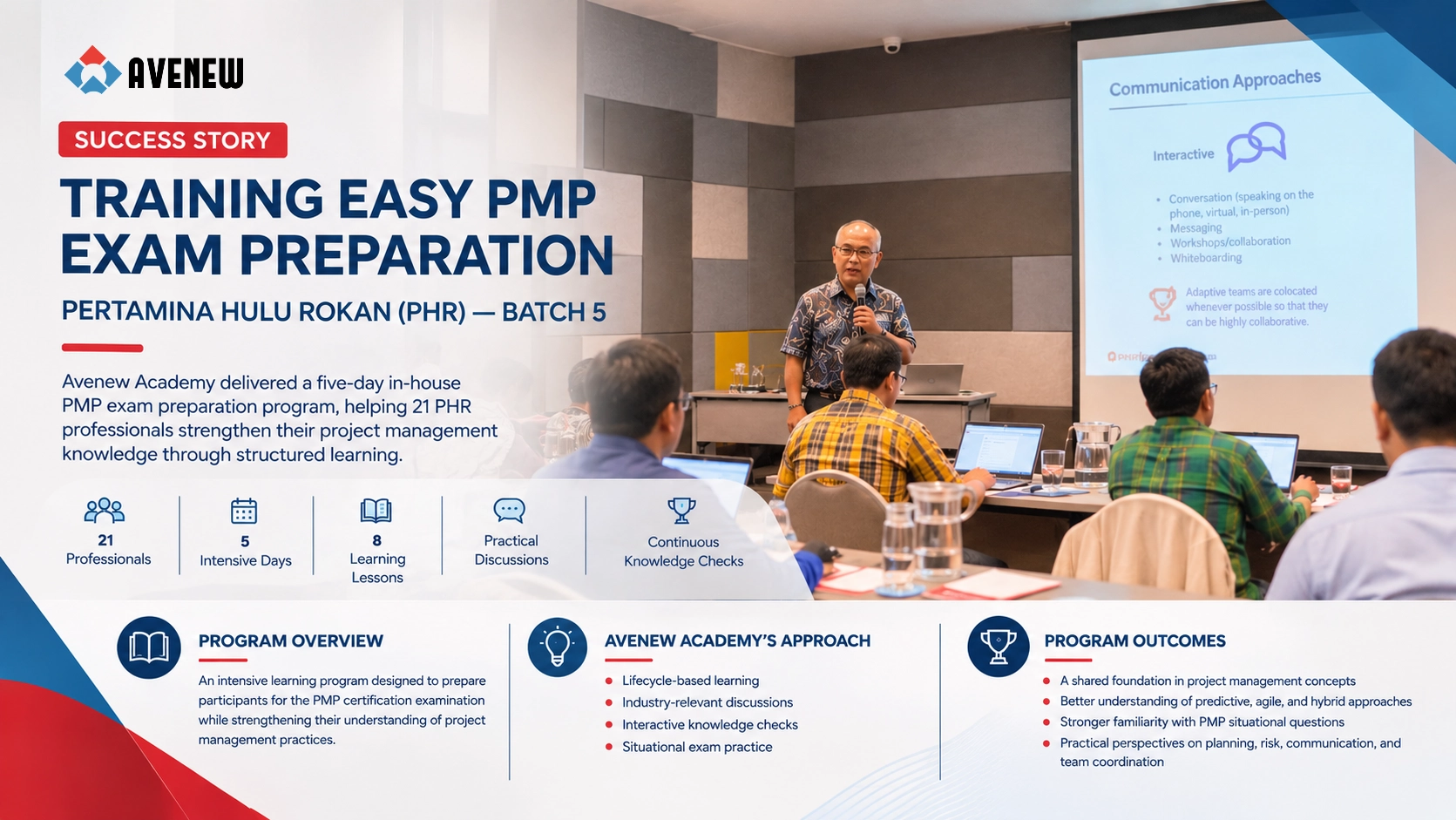
Avenew Academy delivered its fifth Easy PMP Exam Preparation batch for 21 Pertamina Hulu Rokan (PHR) professionals. Across five days, participants explored the full PMP exam curriculum through interactive discussions, practical project scenarios, and exam-style exercises grounded in upstream oil and gas operations.
The Cohort Behind the Program
In 2026, Avenew Academy delivered the fifth batch of its Easy PMP Exam Preparation program for Pertamina Hulu Rokan (PHR), an upstream oil and gas company within the Pertamina group. The in-house program brought together 21 participants, most of them from PHR's Supply Management function in engineering. Over five days, it was led by facilitator Deni Purwadi, MCPM, PMP. The program was designed to prepare participants for the Project Management Professional (PMP) certification examination and to build their project management capability more broadly.
The Readiness Challenge in Upstream Delivery
Upstream oil and gas projects have little room for loose planning. Scope changes, field conditions, contractor coordination and funding constraints all affect whether a project delivers on time and within budget. For professionals working in supply management, project management capability matters directly. Their work shapes how resources, procurement and contracts support delivery on the ground.
The PMP certification sets a globally recognized standard for that capability, but preparing for it is demanding. The exam covers predictive, agile and hybrid approaches. It tests situational judgment rather than recall, and it expects candidates to understand why a project manager would act a certain way, not only what the process is called. For a group of working professionals, the challenge was to absorb this body of knowledge in a short window. They also needed to connect it to the projects they actually handle, so the learning would hold up both in the exam room and on the job.
Avenew Academy's Approach: Learning Along the Project Lifecycle
An Eight-Lesson Curriculum Built on Project Logic
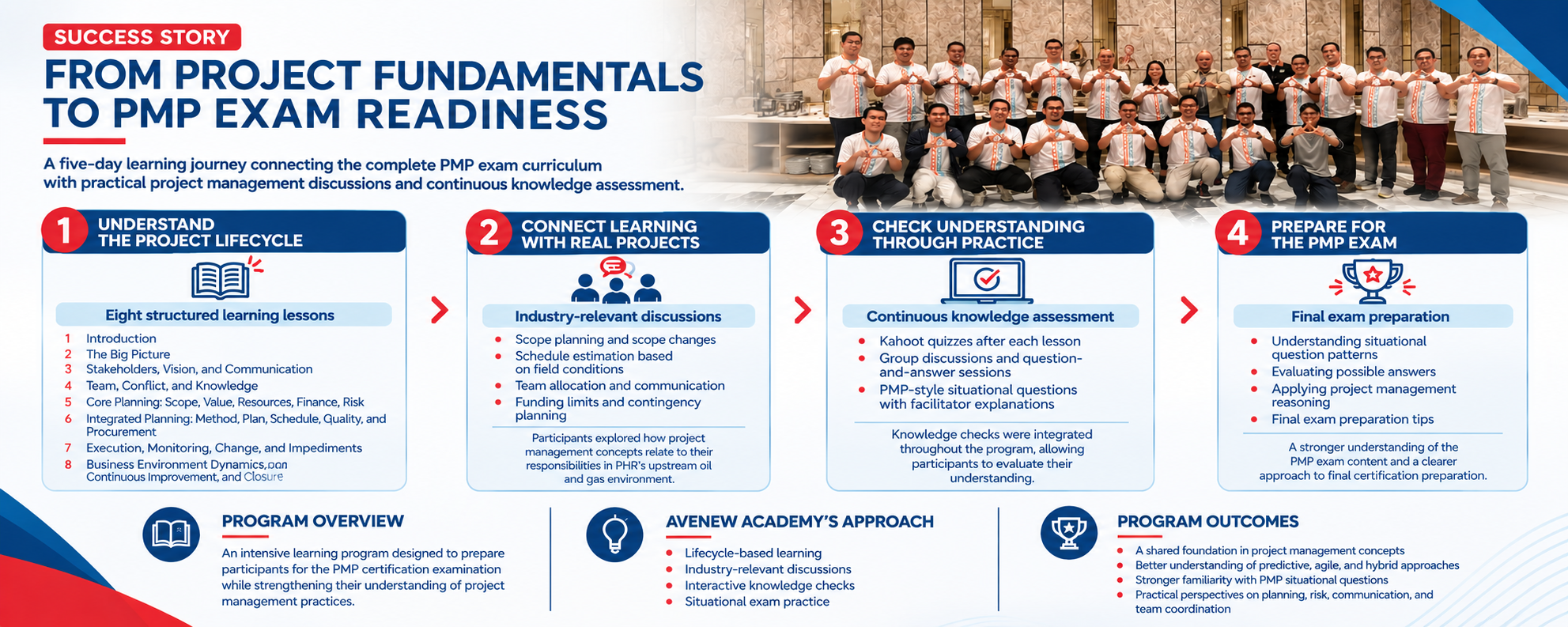
The program ran across five full days, structured as eight lessons. It began with project foundations and the project charter, then moved through stakeholders, vision and communication. It continued with team dynamics, conflict and knowledge management, and core planning across scope, value, resources, finance and risk. The later lessons covered execution, monitoring, change and impediments, and closed with business environment dynamics, continuous improvement and project closure. This sequence follows the lifecycle logic of a project, so participants built each topic on the one before it rather than studying disconnected exam domains.
Grounding Scope and Schedule in Field Realities
The facilitation relied heavily on discussion grounded in participants' own work. In the opening sessions, participants examined how scope planning and scope changes play out in Pertamina's projects. They also explored a question that resonates in any field operation: the gap between a schedule that looks realistic on paper and one that can actually be executed in the field. That discussion led into how activity durations should be estimated so that they reflect real conditions rather than assumption.
The People Side of Project Delivery
As the program progressed, the conversations moved into the human side of delivery. Participants discussed how retrospectives can be used to identify communication barriers, evaluate team coordination and define improvements for the next project. They also discussed the importance of assigning team members according to their expertise and experience, and of recognizing a team's weaknesses through collaboration and clear division of responsibility.
Funding, Contingency, and Agile Estimation
In the core planning lesson, a discussion on funding limit reconciliation led into a practical exchange on how contingency plans are applied within a project. This is a concept with direct relevance to capital-intensive oil and gas work. Agile concepts were also covered, including how story points are used to estimate work within a Scrum team. This gave participants a view of how adaptive approaches sit alongside the predictive planning they work with more often.
Building Readiness for the Certification Exam
Knowledge Checks at Every Lesson
Exam readiness was built into the program from the start rather than saved for the end. Each lesson closed with a Kahoot quiz that gave participants and the facilitator a quick read on how well the material had landed. As early as the third lesson, most participants were answering nearly all of the questions correctly on several items. The quizzes continued through every remaining lesson, keeping comprehension visible as the material grew more complex.
Exam-Style Practice and Final Preparation
Throughout the later lessons, the facilitator worked through examples of question types likely to appear on the PMP exam. He explained the reasoning behind each answer so participants could understand the situational approach the exam uses. The program concluded with a bonus session dedicated to final exam preparation, covering practical tips and what candidates should prepare before sitting for the certification.
Outcome: A Shared Foundation for Certification and Delivery
All 21 participants took part in a program that covered the complete scope of PMP exam content across the full five days. The sessions were consistently described as interactive. Participants asked questions throughout, challenged concepts against their own experience and engaged actively with practice questions. Engagement grew as the program went on, with the final day's sessions on business environment and continuous improvement drawing some of the most active discussion of the week.
The more lasting value lies in how participants worked with the material. By discussing realistic scheduling, contingency planning, team allocation and communication retrospectives in the context of their own projects, participants built a shared project management vocabulary. They also gained a structured way of thinking about problems they already face. For a group drawn largely from one function, this common foundation gives them a more consistent basis for how they plan, coordinate and support project delivery.
Participants completed the program with a full view of the PMP exam's content, a working familiarity with how its questions are framed, and practical guidance on preparing for the exam itself. They are now equipped to move into their final certification preparation with a clear understanding of what the exam expects.
The Capability Behind the Certificate
For Avenew Academy, a program like this is one step in a longer capability journey rather than a standalone course. Certification is an important milestone, but the aim is for professionals to plan more realistically, manage change more deliberately and lead teams more effectively on the projects that matter to their organization. Delivering this fifth batch with PHR reflects that approach: building the people capability behind better project execution, one cohort at a time.