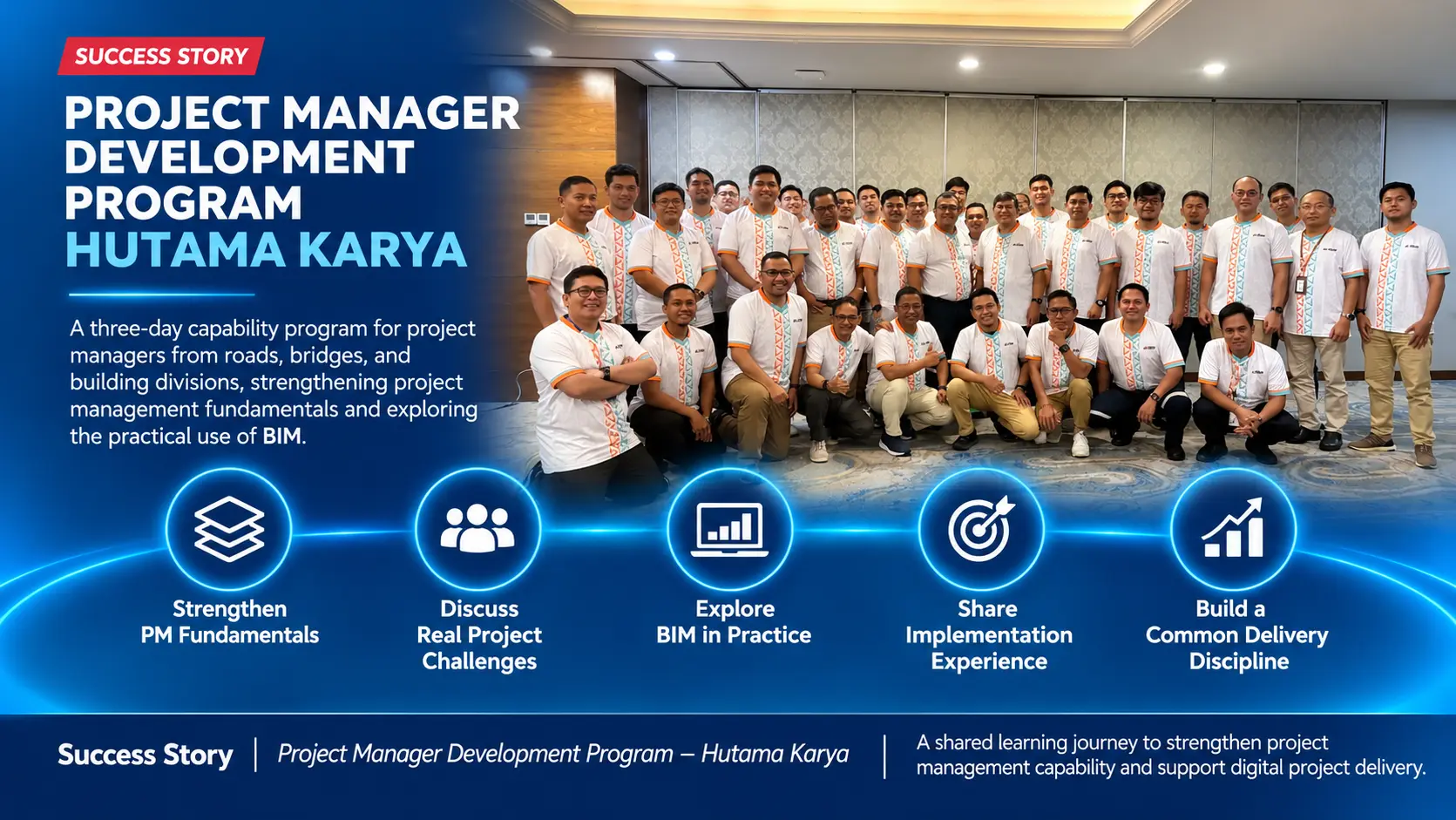
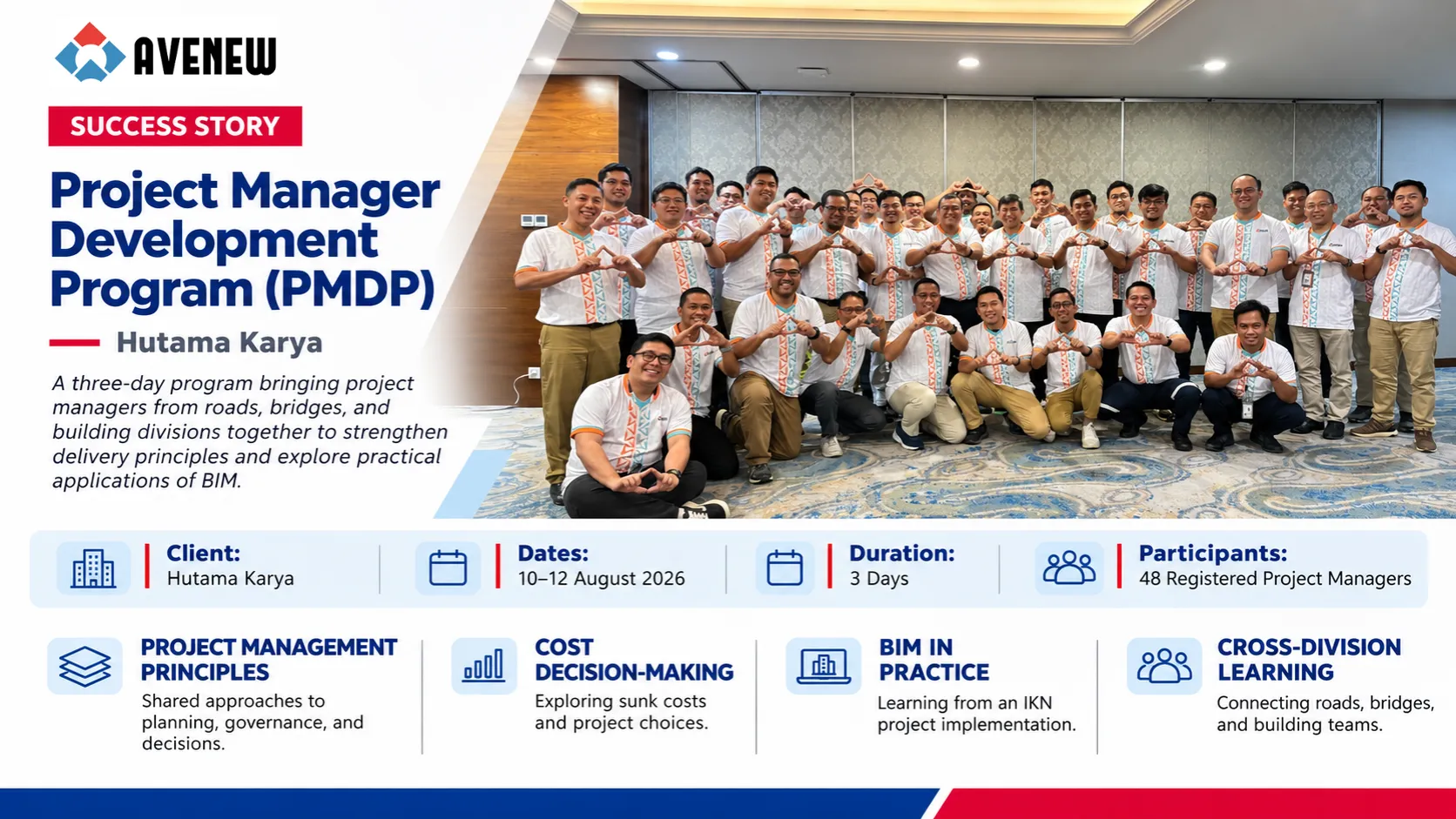
Over three days in August 2026, project managers from Hutama Karya's roads, bridges, and building divisions sharpened their command of project management principles and examined how digital tools like BIM can strengthen the way they deliver infrastructure.
Building the Builders at Hutama Karya
Hutama Karya is one of Indonesia's state-owned construction and infrastructure companies, and its project managers are responsible for some of the most demanding work in the country's development agenda. In August 2026, Avenew Academy delivered the Project Manager Development Program (PMDP) as an in-house program for the company. Forty-eight project managers were registered, drawn from Infrastructure Division I, which handles roads and bridges, and Infrastructure Division II, which focuses on buildings. The three-day program took place from 10 to 12 August 2026.
Two Divisions, One Delivery Discipline
Roads, bridges, and buildings each carry their own technical demands, and project managers who grow up within one type of work often develop their own habits for planning, controlling, and deciding. For an organization delivering a broad portfolio of infrastructure, that diversity is a strength in technical terms, but it also creates a need for a shared foundation. Project managers across divisions benefit from a common understanding of how projects should be governed, how costs and decisions should be evaluated, and how emerging practices fit into everyday delivery.
At the same time, the construction industry is moving steadily toward digital project delivery. Building Information Modeling (BIM) is becoming an important part of how infrastructure projects are designed, quantified, and controlled. Within Hutama Karya, BIM adoption was still developing and had been applied mainly in building projects, with its use centered on quantity measurement. Extending that capability toward broader applications such as cost and risk analysis represents a natural next step, and project managers need to understand both the possibilities and the discipline required to get there.
The PMDP was designed to address both needs together: strengthening core project management capability while widening project managers' perspective on how digital tools can support better delivery decisions.
Principles, BIM, and Lessons From the Field
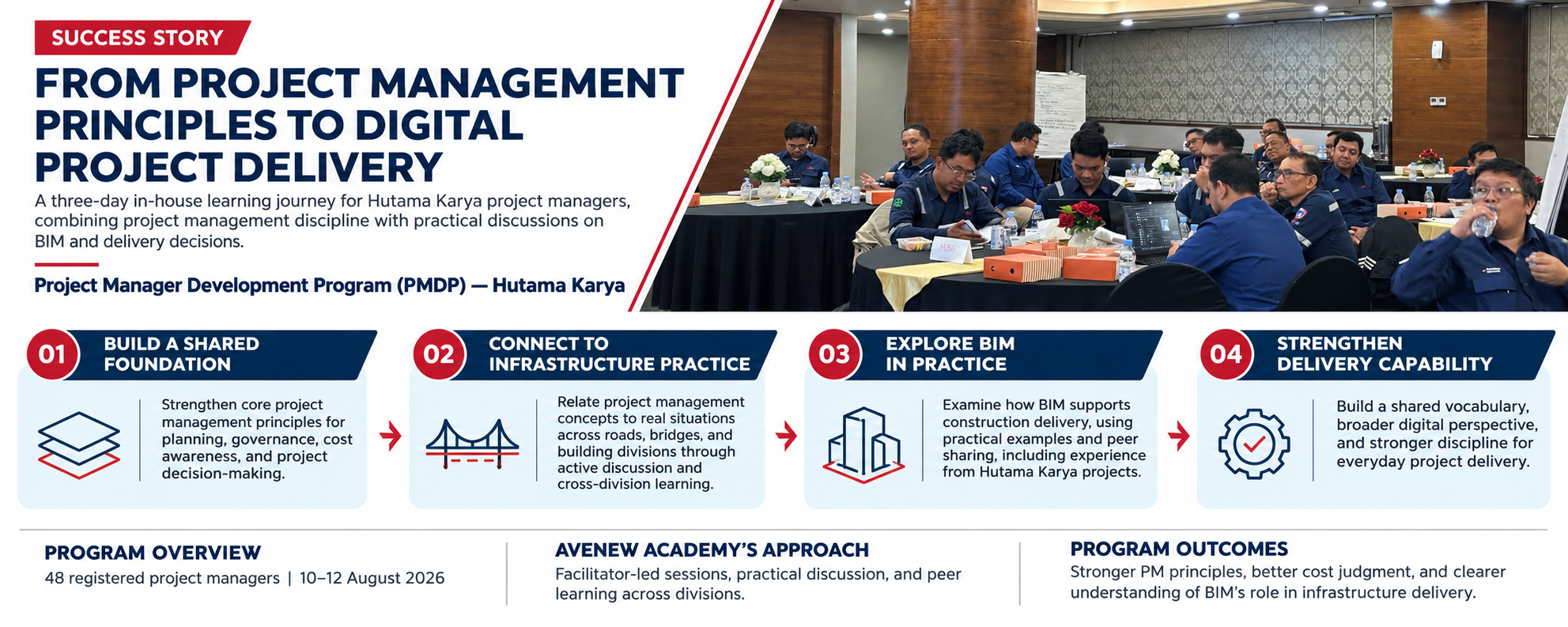
Avenew Academy brought together a facilitation team combining practitioner and academic expertise: Noerachman Saleh, S.T., PMP; Dr. Ayu Herzanita Yufrizal, ST, MT; and Dr. Ir. Rossy Armyn Machfudiyanto, S.T., M.T., IPM., ASEAN Eng. This mix allowed the program to connect internationally recognized project management practice with research-informed perspectives on construction management.
The project management sessions, led by Noerachman Saleh, focused on the principles that guide sound project decisions. One topic that drew particular attention was sunk cost, a concept with direct consequences in construction, where large commitments of money and time can make it difficult to evaluate whether continuing on a given path still makes sense. The volume of questions on this topic showed that participants were relating the material to decisions they face in their own projects.
Dr. Ayu Herzanita Yufrizal led the session on BIM. Her calm and measured delivery style kept participants attentive, and the session generated a steady stream of questions about how BIM can be applied in practice. To ground the discussion in the company's own experience, the session opened space for peer learning. A participant from Hutama Karya presented how BIM had been implemented on one of the company's projects in Indonesia's new capital city, Ibu Kota Nusantara (IKN). This turned the session from a general overview into a conversation about real application, allowing project managers from divisions with less BIM exposure to see what the technology looks like on an active Hutama Karya site.
The program also benefited from the presence of participants who had previously completed PMP training with Avenew Academy. Their familiarity with structured project management concepts helped anchor discussions and encouraged their colleagues to engage.
From Quiet Start to Active Inquiry
Like many in-house programs that bring together colleagues from different units, the PMDP began with a relatively reserved atmosphere, with a smaller group of participants leading the early discussions. As the program moved into its second day, participation broadened noticeably, and more project managers contributed questions and views. This shift matters in a capability program, because the value of in-house training comes not only from the material but from the conversations it opens between people who normally work in separate divisions.
Through the program, participants deepened their understanding of project management principles in the context of their own work, with particular attention to how decisions about cost commitments should be made. They also gained a clearer view of BIM, both its current use within the company and the broader potential it holds for project control. The peer presentation from the IKN project gave participants a concrete reference point, showing that digital delivery capability already exists within the organization and can be shared across teams.
Perhaps most importantly, the program brought project managers from road, bridge, and building work into a shared learning space, giving them common concepts and vocabulary to carry back into their projects.
Capability That Stays on Site
Developing project managers is not a one-time event but an ongoing investment in the people who turn plans into built infrastructure. For Avenew Academy, programs like the PMDP reflect a simple conviction: stronger projects come from stronger project managers, equipped with sound principles, open to new tools, and connected to colleagues who can learn from one another. Supporting Hutama Karya in this effort is part of that broader commitment to building the capability that infrastructure delivery depends on.