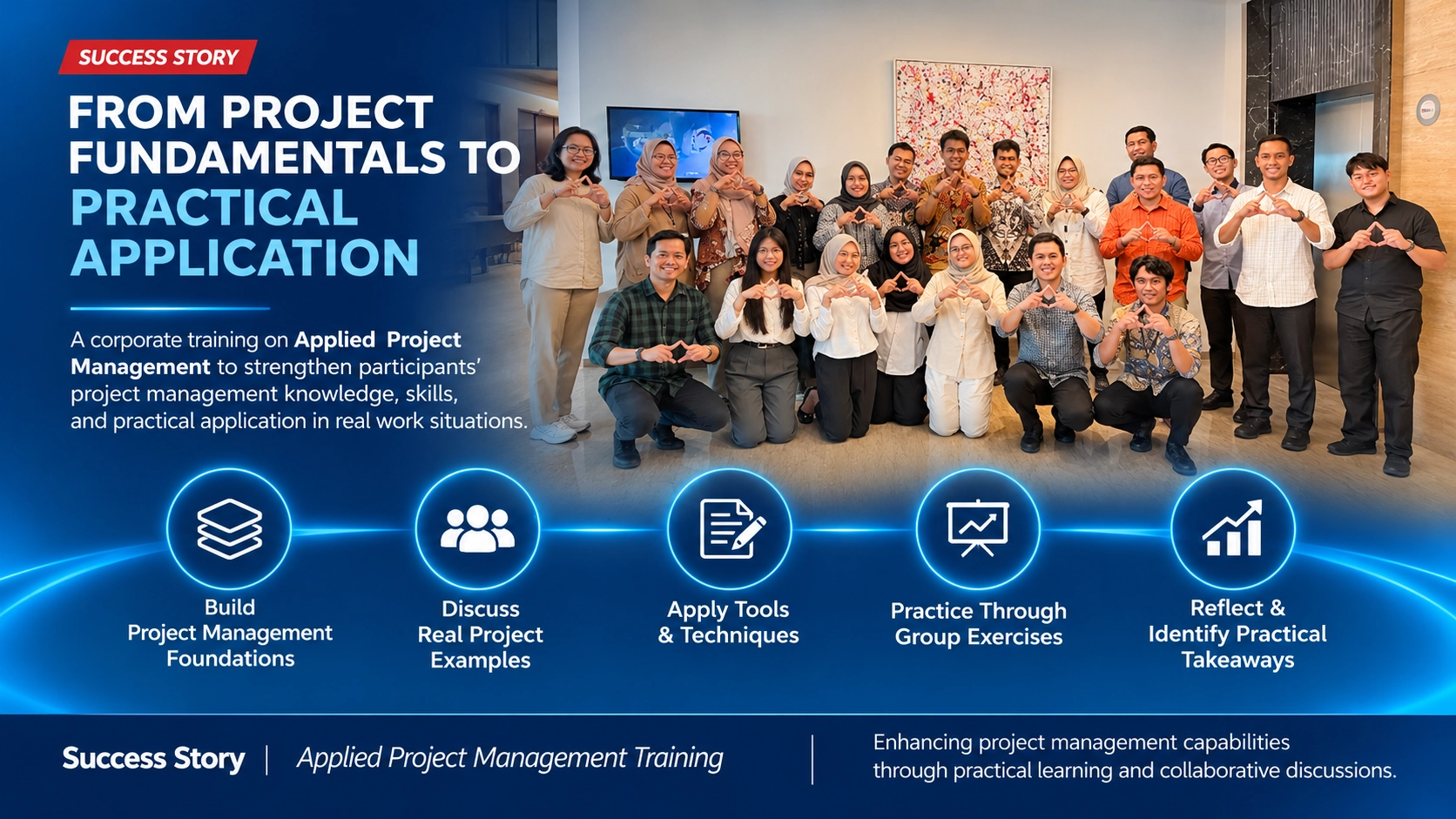
Three days of hands-on project work left Bappenas participants asking not whether project management applies to government, but how to apply it at the level where national programs and portfolios are shaped.
Where National Priorities Take Shape
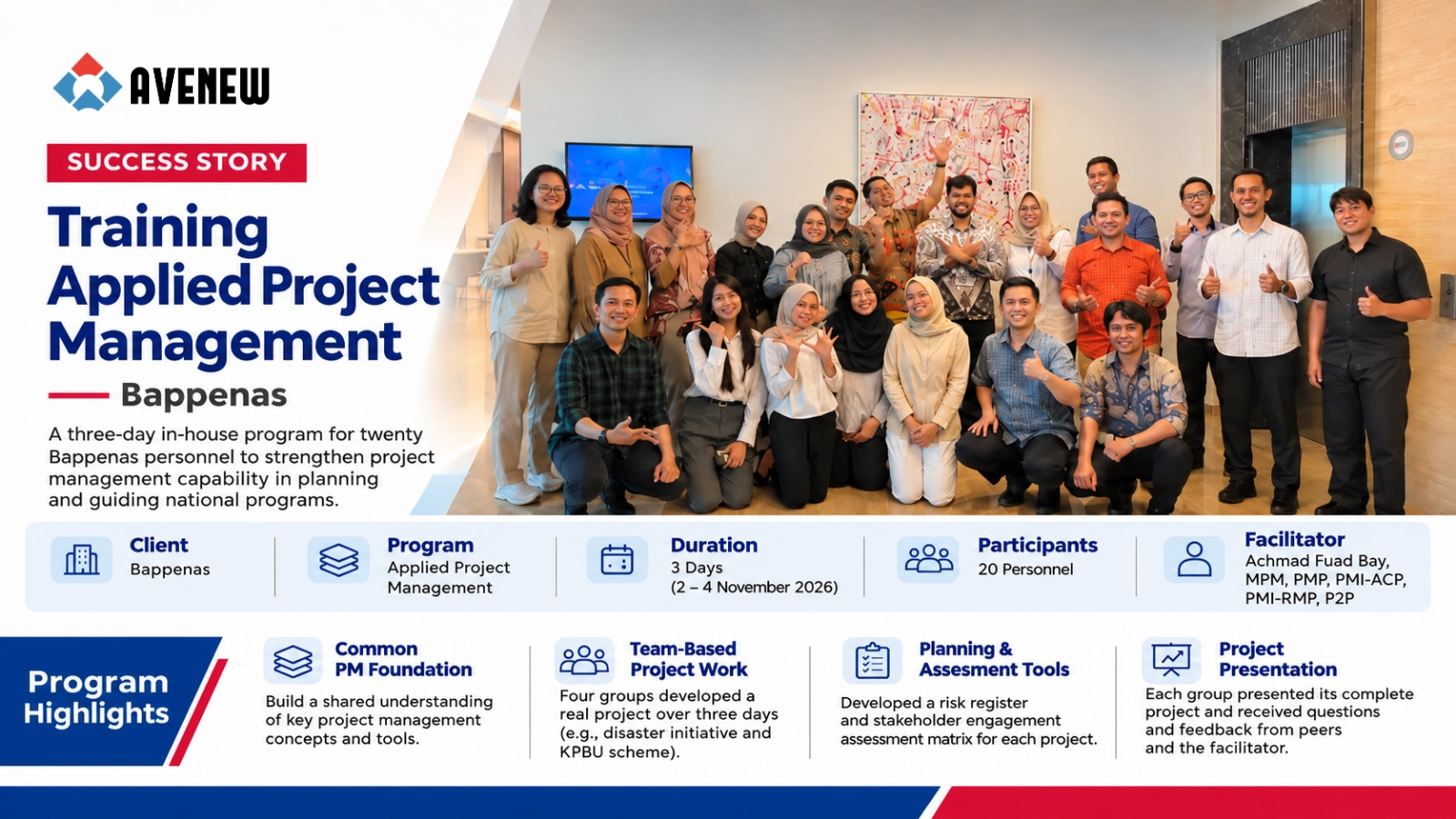
Bappenas, Indonesia’s Ministry of National Development Planning, sits at the point where national priorities are turned into programs that other institutions carry out. From 2 to 4 November 2026, Avenew Academy delivered a three-day in-house Applied Project Management program for twenty Bappenas personnel. The program was opened virtually by the Director of Strategic and Innovative Financing, and brought together participants from different roles and levels of seniority within the institution.
Planning Projects Others Will Deliver
Project management is often taught from the perspective of the team that executes the work. Bappenas operates differently. Much of its work involves planning development initiatives, designing financing schemes such as public-private partnerships, and guiding implementation that other agencies carry out. For people in that position, the value of project management lies less in running day-to-day delivery and more in planning initiatives with discipline, anticipating risks early, and engaging the many stakeholders that national programs depend on.
The participant group also reflected a range of experience. Some participants at middle and senior levels were already thinking about portfolio-level questions, while others needed a firmer grounding in core concepts. The program therefore had to establish a shared project management foundation first, giving everyone the same vocabulary and tools, before participants could meaningfully discuss how those tools fit Bappenas’s institutional role.
Learning Through Projects Built in Teams
The program was facilitated by Achmad Fuad Bay, MPM, PMP, PMI-ACP, PMI-RMP, P2P, whose combined background in project, agile, and risk management shaped a practice-oriented approach. The first day focused on project management fundamentals, deliberately building a common foundation across the group before moving into more applied work.
Rather than treating each topic as a separate lecture, the program organized participants into four groups, each developing a single project over the course of the three days. The projects drew on themes close to participants’ own work, including a disaster-related initiative and a public-private partnership (KPBU) scheme. This meant each new concept was applied immediately to a project the group already understood and cared about.
On the final day, each group built a risk register and a stakeholder engagement assessment matrix for its own project. The facilitator moved between groups, reviewing their work, correcting it directly, and discussing the reasoning behind each choice. These two tools are particularly relevant for a planning institution, since identifying risks and mapping stakeholder positions are central to designing initiatives that can actually be delivered.
The program concluded with each group presenting its complete project, developed across all three days, in sessions of roughly fifteen minutes. Every presentation was followed by questions from other groups and from the facilitator, creating a form of peer review that asked participants to defend their planning decisions in front of colleagues.
From Practice Exercises to Institutional Questions
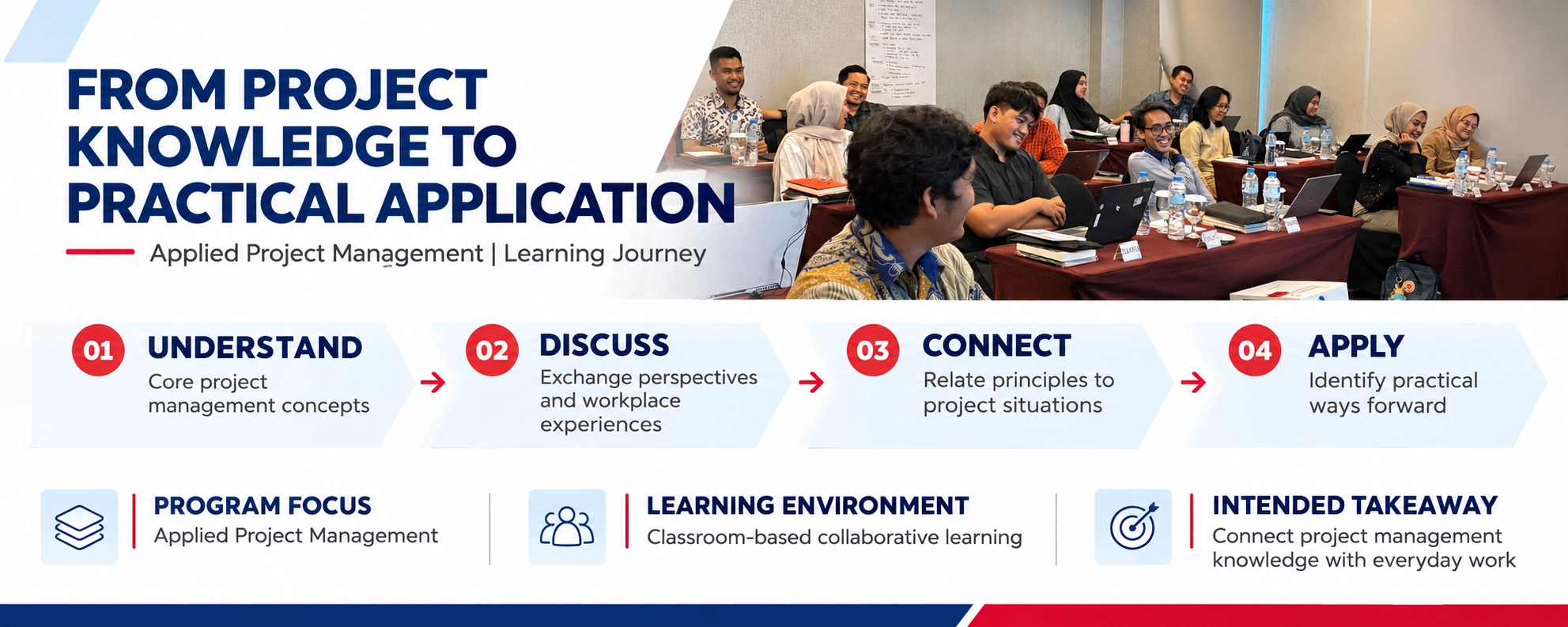
All twenty registered participants were present for the final day, and all four groups presented a full project developed over the program. Throughout the sessions, participants engaged actively, asking frequent questions, debating within their groups, and joining open discussions with the facilitator. The cross-group questioning during presentations showed participants engaging critically with each other’s work rather than simply delivering their own.
The KPBU group was recognized as the most cohesive team, chosen because its members shared the presentation across the whole group rather than relying on a single speaker. It was a small but telling sign that the project had been built collectively.
The most revealing outcome came at the end. The facilitator’s closing session turned into an extended discussion that continued well beyond the formal close of the program. The questions participants raised showed they were already translating the material into their own institutional reality. They asked how project management applies to a government body whose role is planning and guiding execution rather than executing projects directly. They explored how project management roles correspond to Bappenas’s own structure of division heads, directors, and directors general. They discussed how change requests and related control mechanisms could be used in Bappenas projects, and which areas of project management knowledge matter most when managing at the program and portfolio level.
These questions matter because they move beyond the content of a training program and into how an institution might organize its own work. Participants also expressed their appreciation for the program, and indicated that a future batch would benefit from less technical depth and greater emphasis on portfolio management and its business dimension. That request is itself a useful outcome. It identifies the next capability need for the institution with clarity, grounded in what participants had just experienced.
No formal assessment was conducted as part of this program, so these outcomes reflect what participants demonstrated through their group work, presentations, and discussion, rather than measured gains in competency. What the program did establish was a shared foundation and a common set of planning tools across twenty participants, along with a clearer view of where project, program, and portfolio thinking fits within Bappenas’s role.
Capability That Fits the Institution
Project management capability does not look the same in every organization. For a national planning body, it means planning initiatives with structure, seeing risks and stakeholders clearly, and knowing how project, program, and portfolio thinking connect to the institution’s own mandate. Avenew Academy’s work with Bappenas reflects its broader approach to capability development: start from a common foundation, apply it to real work, and let the questions participants raise point the way toward the capabilities they will need next.